The Future of Resurfacing:
My Firsthand Experience with Sciton’s Tribrid Laser
Author:Taylor Siemens, NP-C
Why the world’s first triple-wavelength resurfacing laser is changing the game—and how you can train on it before anyone else.
There’s a new resurfacing laser in town— and it’s not just another aesthetic trend that we won’t be talking about a year from now. When I tested Sciton’s newest innovation, the Tribrid, I quickly realized this technology wasn’t built to replace the Halo… it was built to rewrite what we thought was possible in skin rejuvenation.
Here’s what happened when I tried it myself— and why we’re now training on it at KAT.
When Curiosity Meets Collagen
When I first heard Sciton was launching a laser that fires three wavelengths simultaneously, I knew it was only a matter of time before I found myself under it. The Tribrid promised everything we’ve been chasing in resurfacing—more collagen stimulation, less downtime, and better results across more skin types.
But as any clinician knows, what’s promised in a launch deck doesn’t always translate to the treatment room— or the mirror.
So, I did what every curious aesthetic provider eventually does: I became my own patient.
My Tribrid Recovery, Day by Day
Day 0
After treatment, I did what I always tell my patients to do— sleep elevated, midline, and avoid adding more heat to the skin. No skincare heroics, just hypochlorous acid and cooling masks. My skin was calm, smooth, and after the sunburn feeling subsided in about an hour, all was well.
Day 2
My MENDs (those microscopic epidermal necrotic debris points we all love to explain during consults) appeared and darkened, my face tightened, and my neck felt like it had lived through a Texas summer without AC. Swelling was present—this was the “don’t text your ex or overanalyze your life choices” day of recovery.
Day 3
Swelling was slightly increased, as expected-however, not as much as I have with Halo. That has been the case for each patient I have treated so far as well. The exfoliation phase began. MENDs started to lift, skin felt raw in small areas, and I leaned into hydration and barrier repair.
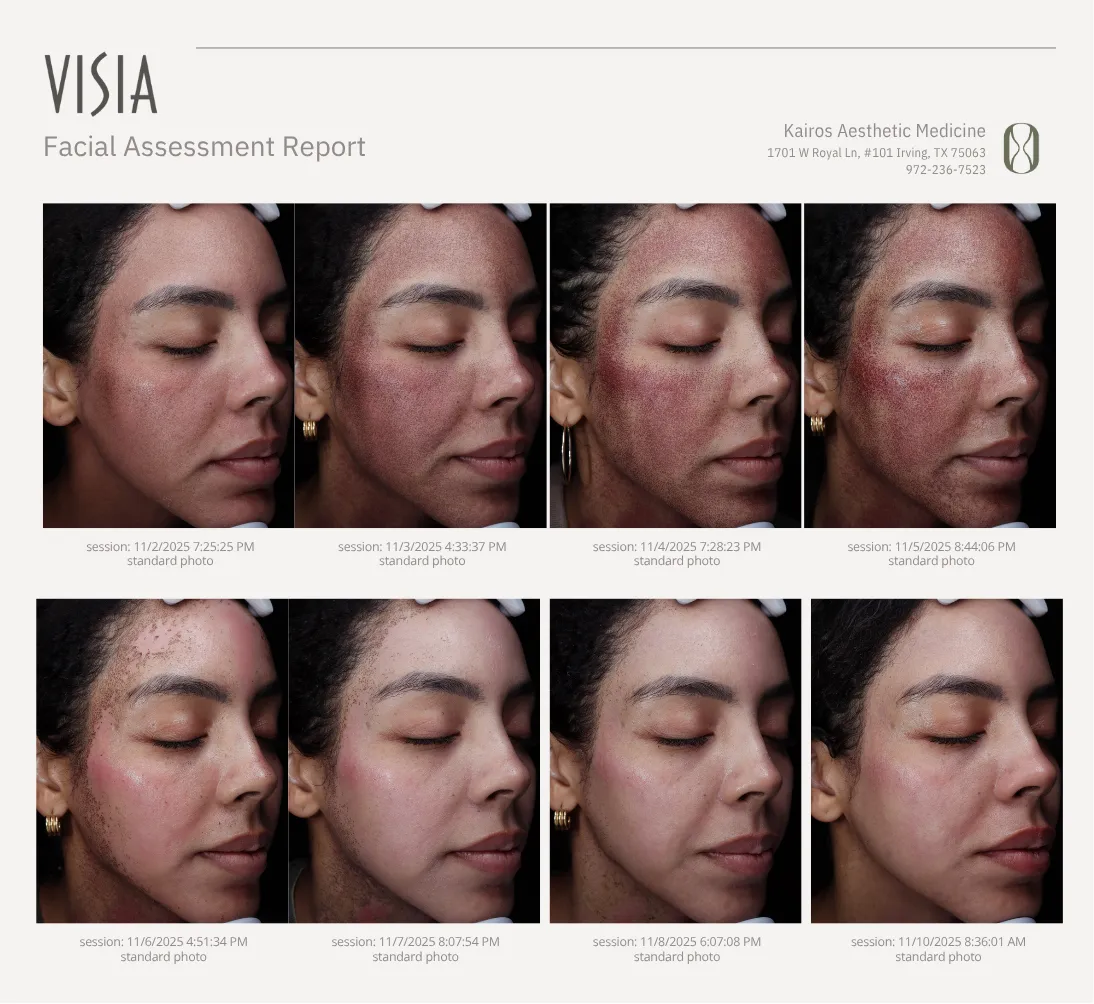
From here, things got better fast. By the end of the week, I was glowing in that way only laser providers can truly appreciate—inside and out.
What Makes Tribrid Different
Tribrid isn’t just another iteration of the Halo or Moxi—it’s a complete evolution in resurfacing.
Where Halo combined ablative and non-ablative wavelengths and Moxi a single non-ablative wavelength, Tribrid introduces a concurrent firing of three wavelengths that allows simultaneous targeting of multiple skin depths and tissue concerns in a single pass.
Translation? More controlled injury, more uniform results, and the kind of collagen remodeling we typically see only after stacking multiple devices.
As a clinician, this is a major shift. It means:
• Greater precision without layering multiple treatments
• More efficiency—one session can achieve what previously required two or three
• Smoother transitions across skin types when paired with accurate skin typing and optimized post-care
It’s as if Sciton took the best parts of Halo, Moxi, ProFractional, and MicroLaserPeel and combined them into one treatment that honestly, just makes sense.
Clinical Insights from the Treatment Room
From a provider standpoint, the Tribrid demands respect. The settings are powerful, the outcomes are striking, and the post-care compliance needs to be airtight.
It’s not a “dabble” device—it’s a commitment to excellence laser. This device demands the clinician to understand skin anatomy to truly customize and maximize settings and outcome potential.
A few pearls from my own experience:
• Hydration is not optional. Patients will need frequent moisturizing, especially days 2–4.
• Plan recovery windows realistically. While most will be ready for makeup around day 5–6, swelling and texture changes are noticeable in the interim.
• Educate early on expectations. Show real photos and emphasize the recovery timeline.
The Tribrid isn’t for the impatient provider—or the impatient patient. But when executed properly, it delivers results that redefine what resurfacing can mean.
Why We’re Training on It at Kairos Aesthetic Training
At Kairos Aesthetic Training (KAT), our goal is to train clinicians on treatments that not only elevate outcomes but also advance the standard of care.
Tribrid does both.
We’re currently offering private Tribrid trainings for Sciton users who want to integrate this technology safely and confidently. And our full Tribrid e-course—covering protocols, anatomy integration, and live treatment demos—will launch before the end of 2025.
If you’re ready to stay ahead of the curve, you can sign up below to be notified when enrollment opens or to schedule private hands-on training with our team.
Because when the technology evolves, so should we.
Copyright 2026 . All rights reserved


